
Introduction
De Beers has been one of the most influential names in the diamond industry since the late 19th century. While the company’s early history is tied closely to the development of mining in Southern Africa, today it operates across several continents, focusing on responsible sourcing, modern technology, and customer confidence. Understanding De Beers requires looking at the complete lifecycle of a diamond—from its ancient formation beneath the Earth’s surface to the unique variations that influence its beauty and value.
1. De Beers: A Brief Overview
Founded in 1888, De Beers played a major role in shaping the modern diamond market. Over the decades, it expanded into exploration, mining, grading, marketing, and luxury jewellery. The company now works through partnerships in countries such as Botswana, South Africa, Namibia, and Canada, supporting both local economies and global diamond supply chains.
Unlike earlier decades, when De Beers dominated rough-diamond distribution, the company now functions within a competitive marketplace. Its focus has shifted toward ethics, transparency, and advanced traceability programs that meet modern consumer expectations.
2. How Diamonds Naturally Form
Natural diamonds begin their journey deep within the Earth, typically 150–200 kilometres below the surface. Under immense heat and pressure, carbon atoms bond together and slowly crystallize over millions or even billions of years. These crystals remain hidden until volcanic activity brings them upward through kimberlite or lamproite pipes.
This geological process is what gives natural diamonds their individuality—no two stones are ever identical, making each gem a small piece of Earth’s history.
3. Diamond Mining and Recovery at De Beers
De Beers uses different mining methods depending on the location of diamond deposits. In some areas, open-pit mines operate at the surface, while elsewhere, deep underground tunnels allow miners to access diamond-bearing rock. Namibia, on the other hand, is home to some of the most advanced marine mining vessels in the world.
De Beers mining methods include:
- Open-pit mining: For near-surface kimberlite bodies.
- Underground mining: For deep ore deposits requiring extensive tunneling.
- Alluvial mining: Where diamonds have been carried away by natural forces.
- Marine mining: Offshore operations that recover diamonds from the seabed.
Each method involves strict environmental controls and continuous investment in safer, more efficient technology.
4. Sorting, Planning, and the Role of Technology
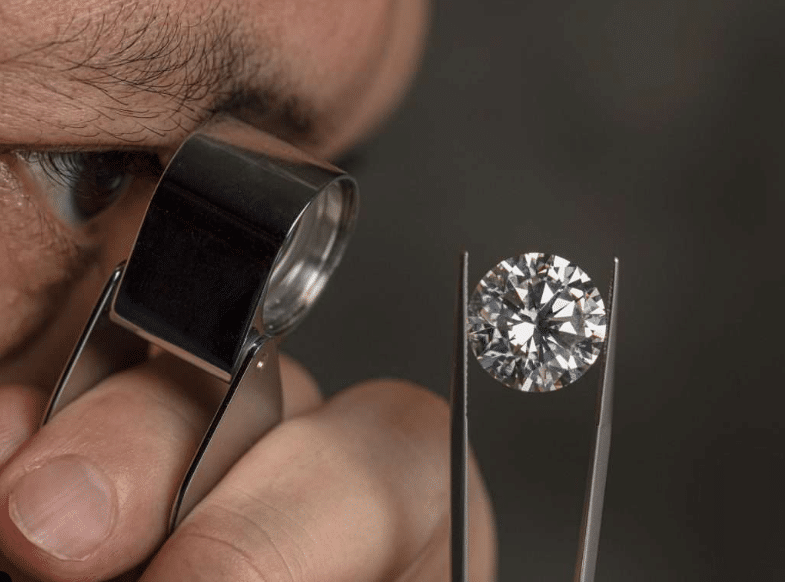
Once diamonds are recovered, they go through a sophisticated sorting system. Instead of simply grouping stones by size, modern De Beers facilities analyze thousands of characteristics. Tools such as 3D mapping, AI-assisted imaging, and laser scanning help specialists understand a diamond’s internal structure and determine how it might be cut.
This planning phase is essential. It influences everything from the final carat weight to the brilliance and value of the polished stone.
5. Cutting and Polishing: Turning Rough Stones into Gems
Transforming a rough diamond into a polished gem requires precision and artistry. Skilled cutters examine the stone’s natural shape, internal features, and crystal direction before deciding how to cut it. The goal is to maximize beauty while preserving as much weight as possible.
A well-cut diamond reflects light in a way that enhances brilliance, fire, and scintillation. This is why cut quality is often considered the most important of all diamond characteristics.
6. Understanding the 4Cs: Cut, Colour, Clarity & Carat
Diamonds are graded worldwide using the 4Cs. These standards help consumers compare stones fairly.
Cut
A diamond’s cut determines how effectively it reflects light. Shapes like round, princess, oval, pear, and emerald each offer a different visual personality.
Colour
White diamonds range from D (colourless) to Z (light yellow/brown). Colourless diamonds are rarer, but many buyers prefer near-colourless options that offer excellent value.
Clarity
Clarity refers to the inclusions or blemishes formed during the diamond’s growth. While flawless diamonds exist, most natural stones contain tiny “birthmarks” that do not affect beauty.
Carat
Carat measures weight, not size. Two diamonds of the same carat can appear very different depending on cut proportions.
7. Diamond Variations: More Than Just Clear Stones
Although many people associate diamonds with a colourless appearance, natural diamonds can form in a wide spectrum of hues. These are known as fancy colour diamonds, and their colours are caused by trace minerals or natural distortions in the crystal lattice.
Some examples include:
- Blue diamonds with traces of boron
- Yellow diamonds influenced by nitrogen
- Pink or red diamonds, believed to result from intense pressure changes
- Green diamonds touched by natural radiation over long periods
Fancy colour diamonds are graded differently, using terms such as Fancy, Fancy Intense, or Fancy Vivid to describe saturation and intensity.
8. Ethical Sourcing and Traceability: The Modern De Beers Approach
In response to growing consumer expectations, De Beers has developed several programs to support transparency:
- Best Practice Principles: Standards covering labour, human rights, and environmental responsibility.
- ORIGIN Program: A digital tracking system that documents a diamond’s sourcing, country of origin, and journey.
- Building Forever: A long-term sustainability framework focused on communities, conservation, and carbon neutrality goals.
These initiatives aim to give consumers confidence that their diamond comes from a responsible and traceable supply chain.
9. From Mine to Jewellery: The Full Diamond Journey
Every De Beers diamond passes through several key stages before reaching a jewellery store. The journey typically includes:
- Formation deep underground
- Extraction through responsible mining methods
- Sorting and scientific evaluation
- Crafting through precision cutting and polishing
- Grading and certification
- Inscription for traceability
- Setting into jewellery
- Final retail presentation
Each step combines natural rarity with human craftsmanship, resulting in a gemstone that tells a story millions of years old.
Conclusion
De Beers continues to play a central role in the global diamond industry by combining geological expertise, technological innovation, and a commitment to ethical sourcing. From the ancient formation of diamonds beneath the Earth to the modern variations that give each stone its character, the journey reflects a blend of science, nature, and artistry.
Understanding this process not only helps buyers make informed decisions, but also deepens appreciation for the rarity and individuality of every natural diamond.