
Historic Display of the Saint’s Bones Draws 400,000 Pilgrims to Assisi
Assisi has once again become the spiritual heart of the Catholic world.
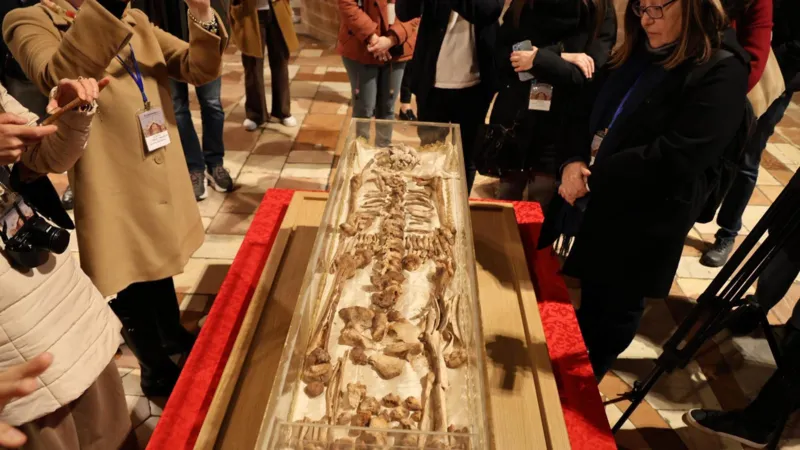
The remains of St Francis of Assisi are on public display at the Basilica of St Francis of Assisi, marking 800 years since his death in 1226. For the first time in modern history, the saint’s skeleton is visible to the general public inside a nitrogen-filled glass shrine placed before the altar of the Lower Basilica.
Nearly 400,000 people have reserved a place to view the relics before the exhibition closes on 22 March, transforming the quiet Umbrian hill town of Assisi into a global centre of pilgrimage once more.
“This is not simply a display of bones,” one church official said during the opening liturgy. “It is a renewal of a message that still speaks to the modern world.”
The Anniversary That Reopened History
The exhibition commemorates the 800th anniversary of Francis’s death. Public access to his remains has been exceptionally rare. They were previously shown only once in 1978 and then to a limited group.
Church leaders view the anniversary as an opportunity to reconnect Catholics with Francis’s legacy of humility, poverty and care for creation. In a period when European church attendance has declined and institutions face questions about relevance, the symbolism is powerful.
The saint who rejected wealth is once again at the centre of global attention.
From Merchant’s Son to Radical Reformer
Born in 1181 or 1182 to a prosperous cloth merchant, Francis renounced his inheritance and embraced voluntary poverty. His founding of the Franciscan Order reshaped medieval Christianity, shifting its focus toward service to the poor, simplicity and harmony with nature.
Canonised just two years after his death, he quickly became one of Christianity’s most influential figures. Pilgrims began travelling to Assisi almost immediately, turning the town into an international spiritual crossroads.
“Francis challenged power with humility,” a Franciscan friar noted. “That challenge still resonates.”
Why Relics Still Matter
In Catholic tradition, relics are physical links to holy individuals and expressions of continuity between past and present faith. The decision to display the saint’s bones inside a climate controlled glass shrine reflects a careful balance between modern conservation science and ancient devotional practice.
For believers, the experience is deeply personal. For historians, it is a rare encounter with a figure who shaped Western religious history.
Geography That Shaped a Movement
Assisi’s significance is inseparable from its location. Situated in Umbria along historic trade and pilgrimage routes linking Rome with northern Europe, the town was strategically positioned to receive medieval travellers.
The Basilica itself, now a UNESCO World Heritage Site, became a landmark of medieval architecture and early Renaissance art. Its frescoes helped define European visual culture.
Today, improved transport connections allow pilgrims to reach Assisi from Rome in just a few hours, making large scale attendance possible. Geography once enabled medieval pilgrimage and it continues to sustain modern religious tourism.
Faith and the Local Economy
The impact on Umbria is substantial.
With hundreds of thousands of visitors expected, hotels are reporting near full occupancy. Restaurants, local artisans and transport services are experiencing a surge in demand. Temporary employment has increased to manage security and hospitality needs.
Religious tourism has long been an economic pillar in central Italy. For a region with limited industrial base, pilgrimage offers both stability and international visibility.
At the same time, the event prompts debate. Some critics question whether large scale exhibitions risk commercialising sacred relics. Supporters counter that pilgrimage has always intertwined faith and commerce, even in Francis’s own era.
A Saint for the Modern Age
Francis is widely regarded as the patron saint of animals and the environment, themes that resonate strongly amid contemporary climate concerns and social inequality.
The late Pope Francis consciously chose his papal name to reflect those ideals, reinforcing environmental responsibility and institutional humility at the highest level of the Church.
The exhibition therefore carries symbolic weight beyond commemoration. It reasserts values that many believe are urgently needed today.
Bones That Still Speak
Eight centuries after his death, the son of a cloth merchant continues to draw the world to Assisi.
His remains, preserved with scientific precision and displayed with solemn reverence, remind pilgrims of mortality, endurance and faith. The exhibition will end on 22 March. The questions it raises about humility, justice and stewardship will not.
In the stone vaults beneath frescoed ceilings, history feels immediate. Francis’s life, rooted in poverty and compassion, stands in quiet contrast to the anxieties of the modern age.
And in that contrast, many visitors say, lies his enduring power.