
Myanmar formally launched its general election process on December 28, 2025, marking the country’s first nationwide vote since the 2021 military coup that abruptly ended a decade-long experiment with democratic governance.
The election is being conducted under the direct authority of the military-led State Administration Council, prompting widespread criticism from political analysts and international observers. Critics argue that the process is carefully engineered to entrench military dominance rather than offer a genuine democratic choice, falling far short of the standards required for a free and fair election.
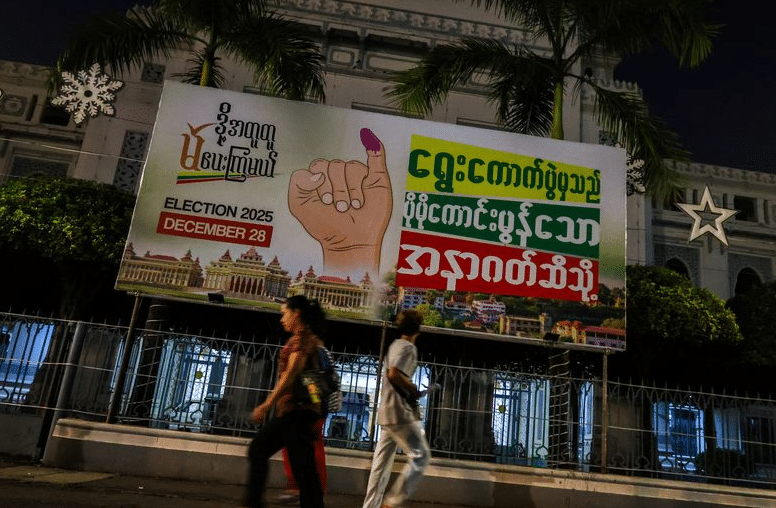
Legacy of the 2021 Coup
Myanmar’s armed forces, known as the Tatmadaw, seized power in February 2021, overthrowing an elected civilian government after alleging widespread electoral fraud. Those claims were later rejected by independent election observers.
Since the coup, Myanmar has remained mired in political instability and violence. Security forces have carried out repeated crackdowns on protesters and resistance groups, while ongoing clashes have resulted in thousands of civilian deaths, mass detentions, and large-scale displacement.
Restrictive Election Rules and Limited Participation
Ahead of the vote, authorities introduced sweeping amendments to electoral laws. The new rules impose strict financial, administrative, and organizational requirements on political parties, severely limiting who can contest seats.
Several opposition parties failed to meet these criteria and were either dissolved or excluded altogether. Nationwide independent election monitoring has not been permitted, further undermining confidence in the process.
Voting is also uneven across the country. Persistent armed conflict has made polling impossible in numerous regions, with large swathes of territory remaining outside effective government control.
Detention of Civilian Leaders
Key political figures remain imprisoned or under heavy restrictions, most notably former civilian leader Aung San Suu Kyi, who is serving multiple sentences following closed-door trials widely condemned by rights groups.
Her party, the National League for Democracy, which won landslide victories in previous democratic elections, was formally dissolved earlier. Its absence has raised serious questions about voter choice and political legitimacy.
Human rights organizations report intensifying repression ahead of the vote, with journalists, activists, and civil society leaders facing constant surveillance. Independent media outlets continue to be censored or shut down.
International Pushback Grows
Western governments have rejected the legitimacy of the election, arguing it fails to meet basic democratic standards. The United States and the European Union have both declined to recognize the outcome.
Human rights organizations echo these concerns, citing mass arrests, lack of transparency, and voter intimidation. The United Nations has called for inclusive political dialogue and the release of political prisoners, demands the military leadership has so far ignored.
ASEAN Remains Divided
Regional responses remain cautious and fragmented. Members of ASEAN have failed to reach consensus on how to respond, with some advocating engagement with Myanmar’s military rulers while others push for stronger diplomatic pressure and sanctions.
ASEAN’s so-called Five-Point Consensus has seen little progress, and Myanmar continues to be excluded from high-level regional meetings.
Junta Claims Versus Public Reality
The military government insists the election will restore stability and pave the way for constitutional governance, describing it as a transition toward what it calls “disciplined democracy.”
Critics strongly dispute this narrative, arguing that the vote merely formalizes military rule. Civilian institutions, they contend, exist largely in name only.
Public trust in the process appears low. Fear, displacement, and economic hardship dominate daily life, leaving many citizens convinced the outcome is predetermined.
An Uncertain Road Ahead
Analysts warn the election may further entrench Myanmar’s political crisis rather than resolve it. Armed resistance groups have rejected the process outright, and there are no visible signs of a negotiated settlement.
Economic recovery remains fragile amid sanctions and instability, while humanitarian needs continue to grow across conflict-affected regions. Without meaningful inclusivity and reform, prospects for lasting peace remain bleak.
As voting proceeds, Myanmar’s democratic future hangs in the balance. For now, the election appears less a step toward reconciliation than a reinforcement of military control.