
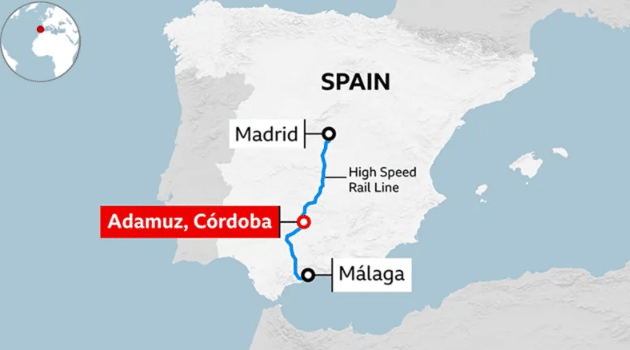
At least 39 people have died and dozens more were injured after two high-speed trains collided in southern Spain on Sunday evening, marking the country’s deadliest rail disaster in over a decade, according to Spain’s Civil Guard.
The accident occurred when a Madrid-bound train derailed and crossed onto the opposite track, colliding head-on with an oncoming train near the town of Adamuz. Around 400 passengers and staff were onboard the two trains. Emergency services treated 122 people, with 48, including five children, hospitalized. Eleven adults and one child remain in intensive care.
Spanish Transport Minister Óscar Puente called the crash “extremely strange” and said railway experts are “extremely baffled by the accident.” He added that the death toll “is not yet final” as investigations continue.
Collision on a Straight Stretch of Track
The crash happened at 19:45 local time, about an hour after the northbound train left Málaga en route to Madrid. The first train derailed on a straight section of track near Córdoba, then struck the southbound train, sending several carriages into an embankment. Most fatalities and injuries occurred in the front carriages of the southbound train.
A spokesperson for the Italian rail company Ferrovie dello Stato confirmed the trains involved were Freccia 1000 models, capable of speeds up to 400 km/h (250 mph). Rescue teams described the wreckage as severely twisted, making it difficult to reach passengers trapped inside.
Córdoba fire chief Francisco Carmona told RTVE, “We have even had to remove a dead person to be able to reach someone alive. It is hard, tricky work.”
Survivors Describe Horror
Journalist Salvador Jimenez, who was on one of the trains, recalled: “I was in the first carriage. There was a moment when it felt like an earthquake and the train had indeed derailed.”
Passengers described chaotic scenes, with some carriages tipped onto their sides. José, a passenger on the Madrid-bound train, said, “There were people screaming, calling for doctors.”
Rail Disruptions and Emergency Response
All rail services between Madrid and Andalusia were suspended after the crash. Iryo, the private company operating the northbound train, reported around 300 passengers onboard, while the southbound Renfe train had about 100.
Advanced medical posts were established near the crash site. The Spanish Red Cross deployed emergency support teams to assist passengers and provide counseling to families. Miguel Ángel Rodríguez of the Red Cross said, “The families are going through a situation of great anxiety due to the lack of information. These are very distressing moments.”
Authorities set up dedicated spaces for relatives at major stations including Atocha, Seville, Córdoba, Málaga, and Huelva. Families were urged to contact survivors to confirm their safety.
National and International Reactions
Spain’s Prime Minister Pedro Sánchez called the disaster a “night of deep pain.” Adamuz Mayor Rafael Moreno, one of the first at the scene, described it as “a nightmare.” King Felipe VI and Queen Letizia extended condolences, saying they were following the tragedy “with great concern.”
International leaders also expressed sympathy. French President Emmanuel Macron said, “My thoughts are with the victims, their families, and the entire Spanish people. France stands by your side.” Italian Prime Minister Giorgia Meloni and European Commission chief Ursula von der Leyen issued similar statements.
Investigations Underway
The cause of the crash remains unknown. Officials said the investigation could take at least a month. Experts have noted the unusual nature of a derailment on a straight section of track, with no immediate explanation yet identified.
Spain’s high-speed rail network, the second largest in the world, spans more than 4,000 km and connects over 50 cities. Its previous worst accident occurred in Galicia in 2013, when a train derailment killed 80 people and injured 140 others.
Safety Concerns and Prevention Measures
High-speed train accidents can stem from mechanical failures, signaling errors, human mistakes, or natural obstacles. The Transport Ministry emphasized preventive measures such as regular inspections, automated speed controls, emergency preparedness, and real-time monitoring.
Minister Puente said, “We must understand what happened to ensure that nothing like this occurs again,” signaling a review of rail safety protocols and infrastructure.