
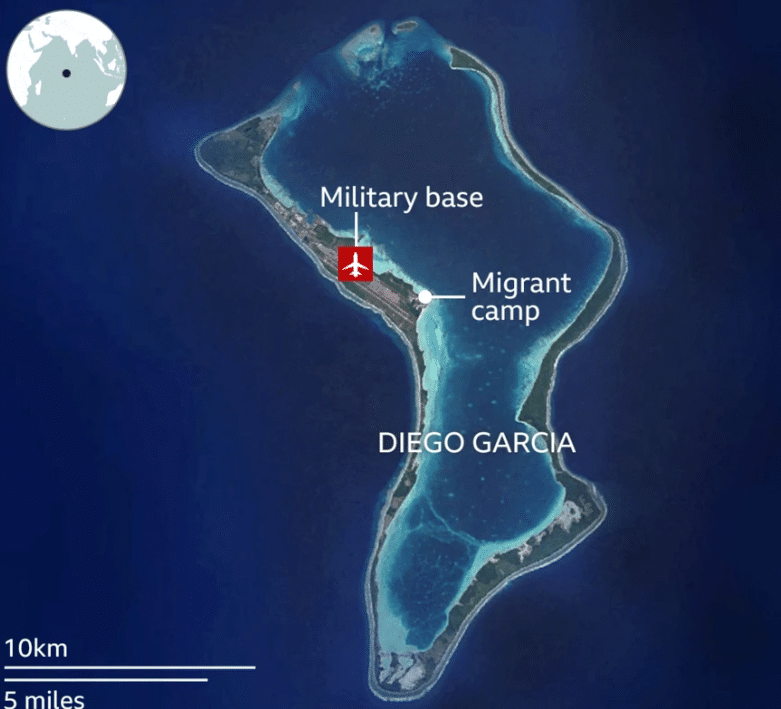
In an era of intensifying great-power competition, territorial decisions carry profound implications for global security. From Washington’s perspective, the United Kingdom’s agreement to transfer sovereignty of the Chagos Archipelago to Mauritius, while retaining a long-term lease on the Diego Garcia military base, has become a flashpoint in a wider geopolitical debate. President Donald Trump, who initially endorsed the deal, has now denounced it as a symbol of allied weakness, using it to reinforce his argument for more assertive U.S. territorial actions elsewhere.
Why the Indian Ocean Base Matters
Located at the center of the Indian Ocean, Diego Garcia remains one of the most strategically significant military installations in the world and a key component of the Chagos Archipelago. The atoll enables rapid U.S. and UK power projection across the Middle East, Africa, South Asia, and the Indo-Pacific, supporting long-range bombers, naval operations, intelligence collection, and space surveillance missions.
Treaty Terms and Strategic Continuity
The strategic value of Diego Garcia was reaffirmed under the UK–Mauritius treaty signed on May 22, 2025. Under the agreement, Mauritius gains sovereignty over the Chagos Archipelago, while the UK retains operational control of Diego Garcia through a 99-year lease costing £101 million annually. The arrangement resolved a decades-long decolonization dispute while ensuring uninterrupted U.S. and UK military access.
Evidence of Ongoing Military Readiness
Satellite imagery from 2026 shows U.S. B-2 bombers stationed on Diego Garcia, highlighting the continued operational relevance of the base within the Chagos Archipelago. The presence of strategic bombers underscores the atoll’s role in high-stakes deployments and its importance in maintaining U.S. deterrence capabilities across multiple regions.
Trump’s Public Reversal
Trump’s criticism of the Chagos Archipelago agreement emerged abruptly on January 20, 2026, through a Truth Social post. He labeled the handover an “act of GREAT STUPIDITY” and “total weakness,” arguing that even with the Diego Garcia lease intact, the decision signals vulnerability to adversaries. “There is no doubt that China and Russia have noticed this act of total weakness,” Trump wrote, claiming the UK was giving away “extremely important land” for “NO REASON WHATSOEVER.”
From Endorsement to Condemnation
The comments marked a sharp pivot. Just months earlier, Trump and senior U.S. officials had supported the Chagos Archipelago deal, describing it as a “monumental achievement” that secured the long-term future of Diego Garcia. Analysts suggest the reversal reflects broader political frustrations rather than a reassessment of security conditions in the Indian Ocean.
Linking the Deal to Greenland
Trump explicitly tied his criticism of the Chagos Archipelago agreement to his renewed campaign for U.S. control of Greenland. In his post, he argued that the decision over Diego Garcia was “another in a very long line of National Security reasons why Greenland has to be acquired,” framing both territories as essential for countering Chinese and Russian influence.
Arctic Parallels in U.S. Strategy
While geographically distant from the Chagos Archipelago, Greenland occupies a similar place in Trump’s strategic worldview as Diego Garcia. The Arctic territory is critical for missile defense, radar systems, and access to emerging shipping routes. Trump has described U.S. ownership as an “absolute necessity,” intensifying pressure on European allies through tariff threats and uncompromising rhetoric.
European Pushback and NATO Strain
European leaders have condemned Trump’s territorial rhetoric, rejecting comparisons between Greenland and Diego Garcia in the Chagos Archipelago. Denmark and Greenlandic officials have emphasized self-determination, while announcing increased military deployments. The dispute has heightened tensions within NATO, raising concerns about alliance cohesion.
A Shift Toward Unilateralism
The controversy surrounding the Chagos Archipelago and Diego Garcia reflects a broader shift in U.S. foreign policy under Trump. By publicly rebuking the UK, a key NATO ally, Trump has signaled a willingness to prioritize territorial leverage and military dominance over diplomatic consensus. As discussions continue at international forums, the episode underscores how strategic assets like Diego Garcia are reshaping global power politics.