
A landmark pact reshapes economic ties as India and Europe respond to protectionism, geopolitics, and global uncertainty
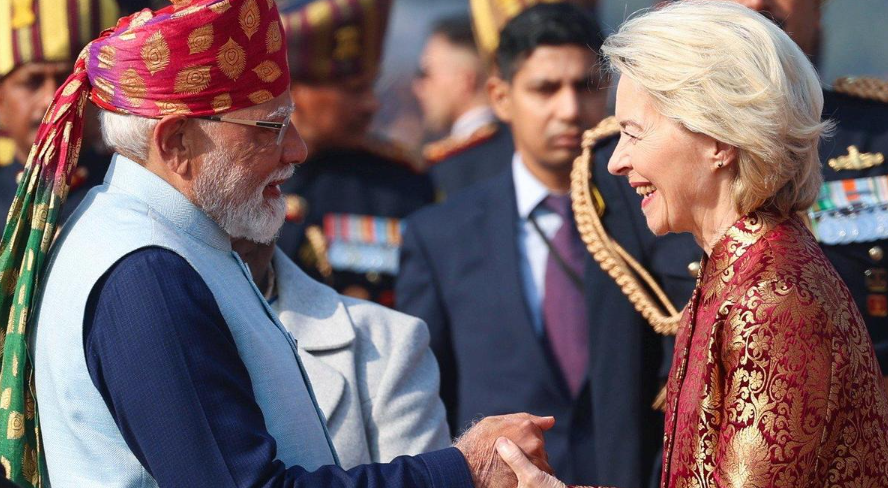
In a landmark announcement on January 27, 2026, during the 16th India–EU Summit in New Delhi, Prime Minister Narendra Modi hailed the conclusion of negotiations for the India–EU Free Trade Agreement (FTA) as the “mother of all deals.” Finalised after nearly two decades of intermittent talks, the pact arrives at a moment when global trade is under strain from protectionism, geopolitical tensions, and fragile supply chains.
With European Commission President Ursula von der Leyen and European Council President António Costa in attendance, following their historic participation in India’s Republic Day parade, the agreement signals a deepening strategic partnership between the world’s largest democracy and the 27-nation European Union. As the global economy absorbs the shocks of U.S. tariff threats and the ongoing fallout from the Russia–Ukraine war, the FTA positions India and the EU as key stabilising forces in an increasingly fragmented world order.
“A successful India is in the world’s interest,” EU leaders said, underlining the strategic weight of the pact.
The Long Road to Agreement: Persistence, Patience, and Compromise
India–EU economic relations date back to the early 1960s, when India was among the first countries to establish diplomatic ties with the European Economic Community, the EU’s precursor. Trade cooperation deepened with the 1994 Cooperation Agreement, which institutionalised dialogue on trade, investment, and technology.
The ambition for a comprehensive FTA emerged in 2007, reflecting optimism for a wide-ranging deal covering goods, services, investment, and intellectual property rights. However, negotiations soon ran into difficulties. India raised concerns over agricultural tariffs and dairy subsidies, while the EU pushed for stronger labour and environmental standards and tighter protection of geographical indications such as Champagne and Roquefort.
Talks stalled in 2013 as differences hardened. Momentum returned only in 2022, driven by lessons from the COVID-19 pandemic and the Russia–Ukraine conflict, both of which exposed the fragility of global supply chains. Europe sought to reduce dependence on China, while India looked to expand exports and attract investment in manufacturing and green energy.
What makes this journey exceptional is the resilience on both sides. Unlike India’s quicker FTAs with the UAE or Australia, the EU agreement required alignment across 27 member states, testing diplomatic endurance. External pressures hastened the breakthrough. U.S. Treasury Secretary Scott Bessent’s criticism of Europe’s purchase of Indian-refined Russian oil, coupled with renewed tariff threats from Washington, sharpened the incentive for closer India–EU cooperation.
This agreement also reflects an evolution from colonial-era economic ties to a modern, balanced partnership, coinciding with two decades of the India–EU Strategic Partnership.
Why This Deal Stands Out: Scale, Timing, and Strategic Depth
The India–EU FTA is notable for its breadth and its timing. Covering more than 90 percent of traded goods and services, it creates access to a combined market of nearly two billion people and around 25 percent of global GDP, estimated at $27 trillion.
Unlike narrower trade agreements, it includes provisions on sustainable development, digital trade, and supply chain resilience. These elements respond to present-day challenges such as climate change, technological sovereignty, and economic security.
The geopolitical context adds to its significance. Announced amid rising U.S. protectionism, the agreement sends what EU leaders described as a strong message against global trade barriers. For India, it reduces over-reliance on the U.S. and China, both of which have seen trade frictions in recent years. For the EU, navigating post-Brexit adjustments and internal divisions, India emerges as a key partner in the Indo-Pacific.
Key concessions reflect a careful balance. India agreed to phased tariff reductions on European automobiles and wines and spirits, while safeguarding sensitive sectors such as agriculture and dairy. These protections were considered essential to shield Indian farmers, a clear political red line for the Modi government.
“This is not just a trade pact, it is a strategic alignment,” a senior official said.
Economic Impact: Trade Expansion and Job Creation
The economic implications are substantial. With current bilateral trade estimated between $136 billion and $190 billion, the FTA is expected to add $30 billion to $50 billion annually. Indian exporters stand to benefit from zero or reduced tariffs on textiles, pharmaceuticals, gems and jewellery, leather, footwear, and engineering goods.
Services, particularly IT and professional services, are expected to gain from improved market access and mobility provisions, potentially generating millions of jobs. Indian exports could rise by $3 billion to $5 billion in the short term.
European companies gain improved access to India’s fast-growing market for automobiles, machinery, chemicals, and wines. Investment is expected to flow into manufacturing, clean energy, and advanced technologies. Indian consumers may benefit from lower prices on European vehicles and electronics.
Challenges remain. The EU’s Carbon Border Adjustment Mechanism could dilute gains for Indian exporters in carbon-intensive sectors such as steel and cement. Still, the agreement is expected to strengthen India’s trade surplus with the EU, currently estimated at $30 billion, and deepen India’s role in global value chains.
Key Sectoral Impact at a Glance
- Textiles and Apparel: Zero tariffs could boost exports by $5 to $7 billion and create up to two million jobs
- Pharmaceuticals: Reduced barriers and technology collaboration may add over $3 billion in exports
- Automobiles: Tariff cuts enable EU market entry while offering consumer savings in India
- Agriculture: Sensitive sectors protected, limiting domestic disruption
- Services and IT: Enhanced mobility and digital trade rules could drive over $10 billion in growth
Geopolitical and Geographical Implications: Redrawing Global Corridors
Beyond economics, the FTA reshapes strategic alignments. It strengthens India’s integration with Europe across the Indo-Pacific, counterbalancing China’s dominance in global supply chains. Cooperation on maritime security, cyber threats, and counterterrorism has expanded, symbolised by the presence of EU naval representation during Republic Day celebrations.
The deal could also anchor connectivity initiatives such as the India–Middle East–Europe Corridor, linking the Arabian Sea to the Mediterranean. While U.S. criticism over Europe’s energy trade with India highlights lingering tensions, the pact reinforces commitment to a rules-based international order.
Public reactions have been largely positive, though some groups have raised concerns over broader political implications, reflecting the complexity of India’s expanding global footprint.
A Defining Moment for India’s Global Role
As legal reviews progress toward implementation by 2027, the India–EU FTA stands as more than a commercial agreement. It reflects India’s attempt to balance rapid growth with social and economic safeguards, protecting domestic priorities while embracing global integration.
In an era defined by trade wars and shifting alliances, January 27, 2026, marks a moment when India asserted itself not as a peripheral player, but as a central architect of the evolving global order. For businesses, policymakers, and citizens alike, the agreement signals the beginning of a more confident and interconnected chapter in India’s international engagement.