
How IMEC Became the Strategic Backbone of the India–EU Trade Renaissance
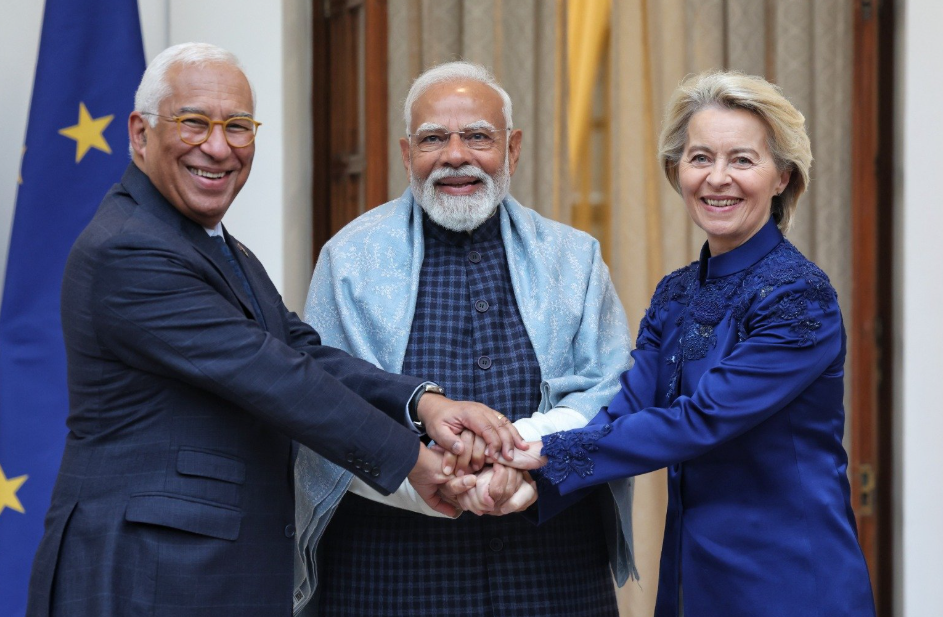
Long before tariffs are cut and containers begin to move, trade is shaped by geography, politics, and trust. When India and the European Union sealed what leaders called the “mother of all trade deals” in New Delhi on January 27, 2026, the headlines focused on numbers: tariffs slashed on over 90 percent of goods, access to a market of nearly 450 million consumers, and bilateral trade poised to double within a decade.
But beneath the Free Trade Agreement’s legal text lies a quieter, more transformative force, one that turns diplomacy into infrastructure and normalization into economic power. At the heart of the India–EU trade renaissance is the India–Middle East–Europe Economic Corridor (IMEC), increasingly described by diplomats as the “Abrahamic Route.”
Together, the FTA and IMEC do more than liberalise trade. They redraw the map of global commerce.
The ‘Mother of All Trade Deals’
Announced at the 16th India–EU Summit after nearly two decades of negotiations, the India–EU Free Trade Agreement marks a decisive strategic shift for both sides. The pact eliminates or sharply reduces tariffs across automobiles, textiles, pharmaceuticals, machinery, agriculture, gems, and jewellery at a moment when global trade is being reshaped by fragmentation, sanctions, and renewed protectionism.
“This is not just a trade agreement. It is a strategic partnership for a fragmented global economy,” a senior Indian official said after the signing.
With bilateral trade already exceeding €120 billion in 2024, EU officials project exports to India could double by 2032. Indian exporters gain unprecedented access to a unified European market at a time when supply chains are diversifying away from China and trade tensions with the United States are resurging under President Donald Trump.
What Gets Cheaper and Faster
The commercial power of the agreement lies in its tariff architecture.
Indian exports to the EU, including textiles, pharmaceuticals, engineering goods, petroleum products, and cut and polished diamonds, see immediate or phased tariff elimination.
European exports to India, notably automobiles, machinery, chemicals, wines, and spirits, receive gradual duty reductions over seven years, protecting sensitive domestic sectors on both sides.
Beyond goods, the deal covers services liberalisation, investment protection, worker mobility, sustainability commitments, and limited defence cooperation.
“This is no longer just about tariffs,” a European diplomat involved in the talks noted. “It’s about trust, resilience, and strategic alignment.”
Why Geography Suddenly Matters Again
Yet trade agreements do not operate in a vacuum. Lower tariffs mean little if goods move slowly, expensively, or through geopolitically fragile chokepoints.
That is where IMEC enters the picture.
Announced at the G20 Summit in New Delhi in September 2023, the India–Middle East–Europe Economic Corridor is a multimodal network linking Indian ports to Europe via the UAE, Saudi Arabia, Jordan, Israel, Greece, and the wider EU. It integrates shipping, railways, energy pipelines, and high speed digital cables into a single trade spine.
By some estimates, IMEC could cut transit times by 30 to 40 percent and reduce logistics costs by around 20 percent, while easing dependence on the Suez Canal and mitigating risks from Red Sea instability.
The India–EU FTA opens markets. IMEC makes them reachable.
Why It Is Called the ‘Abrahamic Route’
The corridor’s significance is not merely logistical. It is profoundly political.
IMEC draws its strength from the Abraham Accords of 2020, which normalised relations between Israel and several Arab states, most notably the UAE and Bahrain. What decades of diplomacy failed to achieve, economic pragmatism unlocked: the ability to imagine shared infrastructure across once hostile borders.
IMEC translates that diplomatic breakthrough into steel, rail, fibre, and pipelines, turning normalization into supply chains.
It also builds on the I2U2 framework linking India, Israel, the UAE, and the United States, positioning the corridor as a strategic counterweight to China’s Belt and Road Initiative without replicating its debt heavy model.
Agreements Beneath the Corridor
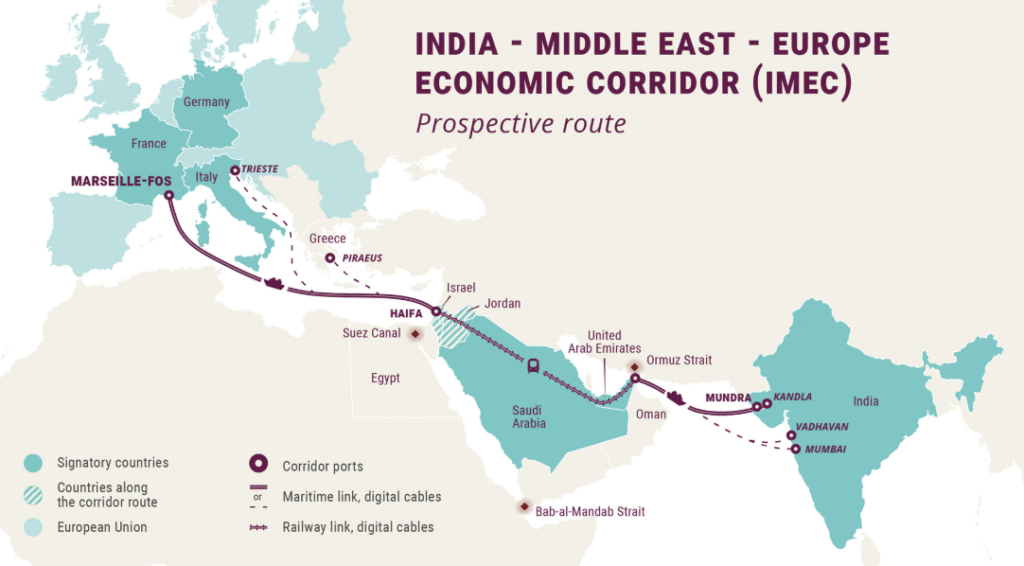
IMEC rests on a web of overlapping commitments rather than a single treaty. A 2023 memorandum of understanding, signed by India, the EU, the US, the UAE, Saudi Arabia, France, Germany, and Italy, anchors cooperation on infrastructure, clean energy, and digital connectivity.
This is reinforced by India’s 2024 FTA with the UAE, expanding energy ties with Saudi Arabia, deep technology collaboration with Israel, and European extensions via the Three Seas Initiative, linking IMEC northward across the continent.
The result is not just a corridor, but an ecosystem.
Winners, Risks, and Reality
Economically, the integration of Indian manufacturing, Gulf logistics, Israeli technology, and European markets creates a powerful trade triangle. Indian textile and gems exports could rise by 20 to 30 percent. EU manufacturers, from Volkswagen to Mercedes-Benz, gain deeper access to one of the world’s fastest growing major economies.
India’s GDP could see an annual lift of 1 to 2 percent, with up to two million jobs created across manufacturing and services.
Yet the promise is fragile. Regional instability remains IMEC’s greatest vulnerability. The Israel–Gaza war of 2024 delayed corridor planning and underscored how dependent the project is on sustained Arab–Israeli détente.
Infrastructure, as planners quietly acknowledge, can only be as stable as the politics beneath it.
A New Model of Multilateralism
Ratification of the FTA is expected by mid 2026. The harder work, regulatory alignment, dispute resolution, and corridor construction, lies ahead.
Still, the broader signal is unmistakable. In an era often described as one of deglobalisation, India and Europe are not retreating from globalisation. They are rewiring it.
Trade is no longer just about goods and tariffs. It is about routes, alliances, resilience, and strategic autonomy.
As one widely shared post on X put it, “This isn’t just trade. It’s Europe’s lifeline in a world it helped fracture.”
The FTA seals the deal.
IMEC charts the course.
Together, they form the backbone of a new multipolar trade order, built across Abrahamic divides and anchored in pragmatic cooperation.