
UK China strategic talks: Starmer and Xi Signal Diplomatic Reset as UK Re-engages China Amid Global Tensions
“Engagement with China, however complex, is no longer optional. It is a strategic necessity.”
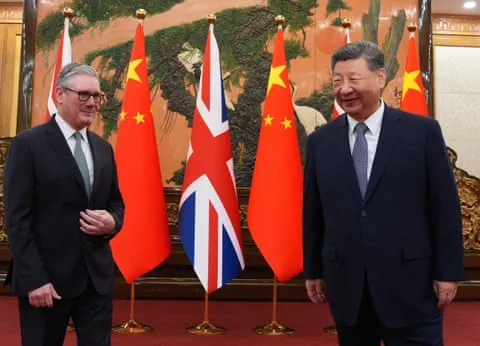
British Prime Minister Keir Starmer’s meeting with Chinese President Xi Jinping in Beijing on January 29 marked a significant turning point in UK–China relations, signaling a cautious but deliberate diplomatic reset after nearly a decade of strain. It was the first visit by a British prime minister to China in eight years,and the symbolism was unmistakable.
Held at Beijing’s Great Hall of the People, the talks stretched to 80 minutes, almost twice their scheduled length. For London, the extended meeting underscored a clear message: the UK is seeking a more stable, predictable, and pragmatic relationship with the world’s second-largest economy at a time of mounting global uncertainty.
“This is about building a long-term, consistent and comprehensive strategic partnership,” Starmer told Xi during the talks.
A Shift Toward Strategic Pragmatism
Subhead: London seeks economic cooperation while insisting on frank dialogue over security and human rights
Starmer arrived in Beijing accompanied by a delegation of nearly 60 representatives from British business, cultural, and academic institutions. His message balanced engagement with caution. China, he said, is a “vital global player,” essential to cooperation on climate change, economic stability, and international security,yet not beyond criticism.
The British prime minister emphasized the need for “meaningful and frank dialogue” on sensitive issues, including human rights and national security, signaling that renewed engagement would not come at the cost of abandoning long-standing concerns.
Xi, for his part, welcomed the overture. He expressed Beijing’s readiness to develop a “long-term strategic partnership” with the UK and reiterated China’s narrative of peaceful development, stating that the country “has never initiated a war nor occupied an inch of foreign land.”
Both sides announced progress on practical cooperation, including measures to combat migrant-smuggling networks. They also discussed the possibility of unilateral visa waivers for British citizens, a move that could significantly boost tourism, business travel, and educational exchanges.
Following the summit, Starmer toured the Forbidden City and was scheduled to meet Premier Li Qiang before traveling to Shanghai for business-focused engagements.
“In a turbulent and fluid world, more dialogue is essential,” Xi said, according to Chinese state media.
Building on Tentative Re-Engagement
Subhead: Months of cautious diplomacy paved the way for January’s high-level talks
The Beijing talks did not emerge in isolation. They followed a gradual thaw in communications, including a phone call between Starmer and Xi in August 2024 and a brief encounter at the G20 summit in Rio de Janeiro later that year. Together, those moments helped reopen channels that had largely fallen silent during years of diplomatic frost.
Starmer’s four-day visit, which began on January 28, aligns closely with Labour’s domestic pledge to improve living standards at home by strengthening economic ties abroad,particularly with major non-Western economies.
From “Golden Era” to Deep Freeze
Subhead: A decade of UK–China relations marked by ambition, breakdown, and mistrust
UK–China relations have swung dramatically over the past decade. In 2015, then–Prime Minister David Cameron declared a “golden era” of cooperation, hosting Xi Jinping in London with full state honors and signing multi-billion-pound agreements spanning finance, infrastructure, and energy. Chinese investment poured into flagship projects, including nuclear power and transport.
That optimism faded rapidly after 2018. Tensions escalated following Beijing’s imposition of a national security law in Hong Kong, which London argued violated the Sino-British Joint Declaration. Relations worsened further under Boris Johnson, particularly after the UK banned Huawei from its 5G networks, criticized human rights abuses in Xinjiang, and offered residency pathways to Hong Kong residents.
The COVID-19 pandemic deepened mistrust, amid accusations over transparency and responsibility. Subsequent prime ministers Liz Truss and Rishi Sunak went further, labeling China a “systemic threat” and aligning UK policy more closely with Washington as tensions flared in the Taiwan Strait.
Labour’s Calculated Reset
Subhead: Starmer reframes China as an economic partner without abandoning strategic caution
Since taking office in July 2024, Starmer’s Labour government has reframed China not solely as a strategic rival, but as an unavoidable economic partner,particularly as Britain grapples with post-Brexit trade realities and tight public finances.
The timing of the visit is strategic. With the prospect of renewed trade confrontation under a future Donald Trump presidency in the United States, London appears keen to position itself as a pragmatic bridge between Beijing and the West.
“This is not about choosing sides,” a senior British official said. “It is about protecting British interests in a multipolar world.”
Wider Geopolitical Implications
Subhead: The reset reverberates across Europe, the Indo-Pacific, and global trade routes
The reset carries implications well beyond bilateral ties. Beijing has long viewed the UK’s Indo-Pacific posture,including naval deployments and participation in the AUKUS security pact,with suspicion. High-level dialogue may help reduce friction affecting key trade routes in the South China Sea, through which a significant share of global commerce flows.
In Europe, closer UK–China engagement could influence debates within the EU, as countries such as Germany weigh economic dependence against security risks. For post-Brexit Britain, expanding Asian partnerships is increasingly central to its global strategy, including its role in the CPTPP,an agreement China has formally applied to join.
Economic Stakes and Strategic Risks
Subhead: Trade opportunities expand, but warnings over dependence remain
China remains the UK’s fourth-largest trading partner, with bilateral trade exceeding £100 billion annually. Starmer’s delegation focused on opportunities in finance, green technology, education, and healthcare. Xi, meanwhile, called for deeper cooperation in education, healthcare, financial services, and other high-value sectors,raising expectations of renewed Chinese investment in UK renewables and infrastructure.
Potential gains include job creation in export-driven industries such as pharmaceuticals and luxury goods, improved access to China’s vast consumer market, and increased tourism if visa rules are relaxed.
Yet risks remain. Critics warn that closer ties could expose the UK to supply-chain vulnerabilities and economic coercion, pointing to past cases involving other countries that fell out of favor with Beijing.
A Diplomatic Bet in a Fragmenting World
Subhead: Britain tests a pragmatic path between engagement and deterrence
Starmer’s Beijing visit reflects a broader shift toward economic realism in an increasingly fragmented global order. The strategy offers potential rewards for a fiscally constrained UK,but only if London can carefully manage unresolved disputes over human rights, espionage, and Taiwan, while maintaining trust with its allies.
Handled skillfully, the reset could become a template for constructive engagement between strategic competitors. Mishandled, it risks political backlash at home and friction abroad.
In an era defined by uncertainty, Britain’s message is unambiguous: engagement with China, however complex, is no longer optional. It is a strategic necessity.