
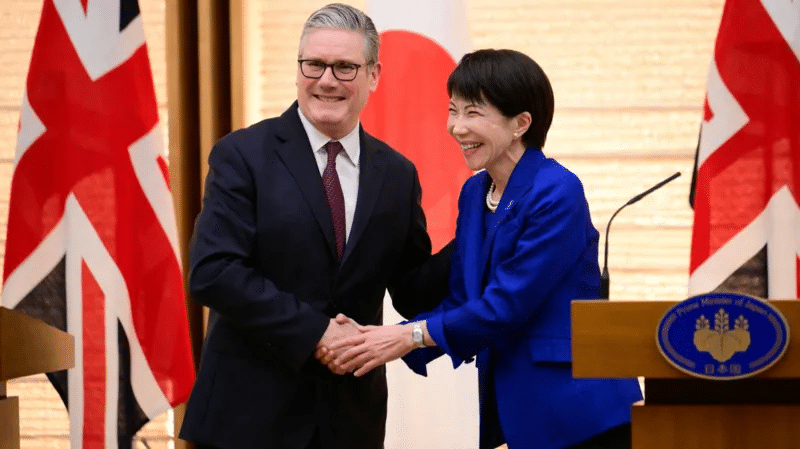
Sir Keir Starmer’s invitation to Japanese Prime Minister Sanae Takaichi to visit the United Kingdom marks more than diplomatic courtesy. It signals a deliberate recalibration of Britain’s role in East Asia at a time of intensifying global instability.
Coming immediately after Starmer’s four-day visit to China, the Tokyo stopover was carefully timed and politically loaded. It underlined London’s attempt to walk a strategic tightrope, reopening economic channels with Beijing while simultaneously reinforcing security and values-based partnerships with key Indo-Pacific allies, most notably Japan.
Starmer described UK–Japan relations as the strongest they have been “in decades”. That assessment reflects years of quiet but steady convergence, and the meeting in Tokyo suggests the relationship is now entering a more overtly strategic phase.
“The UK and Japan share vital interests and principles,” Starmer said. “We have a clear interest in free and predictable trade and in responding with strength and clarity to global instability.”
From Trade Ally to Strategic Partner
Historically, UK–Japan relations were anchored in commerce. Japan became one of Britain’s most significant non-European investors in the late twentieth century, particularly in automotive manufacturing, finance, and technology.
The relationship deepened sharply after Brexit.
Cut off from European Union trade frameworks, the UK accelerated its Indo-Pacific pivot. Japan emerged as a natural partner: a liberal democracy, a technologically advanced economy, and a nation increasingly wary of China’s regional assertiveness.
This convergence led to several landmark agreements, including the UK–Japan Comprehensive Economic Partnership Agreement, the Reciprocal Access Agreement enabling joint military deployments, and participation in the Global Combat Air Programme alongside Italy. The sixth-generation fighter jet initiative symbolises long-term defence alignment between the countries.
Starmer’s visit builds directly on this trajectory, shifting the relationship from continuity to expansion.
Why This Visit Matters Now
China, Taiwan, and Rising Regional Tensions
The talks took place amid heightened tensions over Taiwan. Prime Minister Takaichi’s recent remarks suggesting Japan could be drawn into a China–Taiwan conflict provoked anger in Beijing but boosted her domestic standing ahead of Japan’s snap elections on February 8.
For the UK, the timing was delicate.
Starmer had just concluded talks with Chinese President Xi Jinping, securing visa-free travel for British citizens, tariff reductions on whisky, £2.2bn in export deals, and the lifting of Chinese sanctions on British parliamentarians.
A stop in Tokyo immediately afterward sent a clear signal. Engagement with China does not mean strategic drift from its rivals.
In both private and public remarks, Starmer and Takaichi emphasised the need to respond with “strength and clarity” to growing global instability. In diplomatic terms, the message was unmistakable.
An Election Boost for Tokyo
From the Japanese perspective, Starmer’s presence was politically invaluable.
With elections just days away, the optics of hosting a British prime minister fresh from talks with Xi reinforced Takaichi’s image as a capable global stateswoman. Analysts in Tokyo openly described the visit as an “enormous favour” to her campaign.
For Starmer, it was a calculated risk. While UK officials deny any intent to influence Japanese domestic politics, the visit undoubtedly strengthened an incumbent ally whose worldview closely aligns with London’s.
“The timing of this visit could not be better for Prime Minister Takaichi,” said Jeffrey J Hall of Kanda University of International Studies. “It reinforces her diplomatic credibility at a critical political moment.”
Economic Stakes: Trade, Supply Chains, and Critical Minerals
Economically, Japan remains one of Britain’s most important partners outside Europe.
Discussions focused on free and predictable trade, supply-chain resilience, and cooperation on critical minerals. These resources are essential for semiconductors, electric vehicles, and defence technologies.
The emphasis reflects a broader Western shift away from over-dependence on China-centric supply chains. Japan, already reshoring strategic industries, fits neatly into Britain’s post-Brexit industrial strategy.
The UK increasingly views Japan not only as a major investor but also as a gateway to the wider Indo-Pacific economy, a region projected to drive global growth over the next two decades.
Defence and the Indo-Pacific Pivot
Security cooperation is no longer secondary.
The UK’s increased military presence in the Indo-Pacific, including naval deployments and joint exercises, aligns closely with Japan’s own defence expansion. The Global Combat Air Programme alone ties British and Japanese defence industries together well into the 2040s.
Symbolically, Starmer’s attendance at a ceremonial guard of honour in Tokyo reinforced the message that Britain’s commitment to the region is substantive.
For Japan, the UK offers a nuclear-armed NATO power, diplomatic reach across Europe, and strategic depth beyond the United States alliance. For Britain, Japan provides credibility in a region where influence must be earned rather than assumed.
A Balancing Act Defining Starmer’s Foreign Policy
Starmer’s East Asia tour reveals the emerging contours of his foreign policy doctrine. Engage adversaries economically. Anchor security in alliances. Avoid binary Cold War framing while preparing for systemic rivalry.
The challenge will be sustainability. Britain’s resources are finite, and its ability to balance engagement with Beijing while standing firm with Tokyo will be tested as tensions over Taiwan, Ukraine, and global trade intensify.
Still, the invitation to Chequers and the prospect of a Japanese prime ministerial visit later this year suggest confidence and intent.
From Quiet Alignment to Strategic Visibility
The UK–Japan relationship is no longer defined solely by investment flows or ceremonial diplomacy. It is evolving into a visible strategic partnership shaped by shared values, converging threat perceptions, and economic pragmatism.
Starmer’s Tokyo visit produced no dramatic announcements, and that may be its greatest strength. Instead, it reinforced trust, timing, and alignment at a moment when global politics increasingly rewards clarity over spectacle.
If the coming months bring a Japanese prime minister to London, it will not simply be a return visit. It will be a statement that Britain intends to remain an active and credible player in the Indo-Pacific long after the headlines fade.